Sunday, July 7, 2013

Another good week

Our week was once again very productive. We visited three villages south of the field station, Iruhura, Nyabinyonyi, and Kyakabuzi and between all, 50 farms. In Iruhura I picked up another group of children to add to my growing fan club ( I think my popularity may have something to do with the candy I hand out).

 
We are about 2/3 of the way through the first part of my work. I still have to return to each village I visited in January and give a presentation with data from the soils I collected on that first trip. I also have to send some time with some of the local primary school teachers to find out what kind of things I can do or provide to help them educate their children about soils.

We experienced our first earthquake for this trip this past week, and it was actually a fairly strong one. There was only one that I felt when here in January, but it is not expected since we are so close to the Great Rift. We also had our first significant thunderstorm and rain on Thursday and into Friday. Fortunately, everything has gone so smoothly, we were finished with our field work early so we didn't get wet.

There haven't been as many monkeys around the house this time as there were in January. I guess the trees in our area don't have the same fruits and seeds they did In January to attract them. I did see this big guy out alone in front of the house though.

I guess I'll end this post with some pictures of some of the fields we visited, many of which went right up to the boundary of Kibale National Park.


Sunday, June 30, 2013

Productive first week of field work

We had a very productive and successful first week of field work. We were able to visit 50 different farms to collect soil samples and complete surveys. My work this summer is focused on determining which crops farmers decide to plant, and how they make those decisions. I am also focusing in on maize because it has been pushed as a cash crop in this area and it can be particularly detrimental to soil fertility. I have been asking the farmers, mostly women, how much maize they plant each season, what they intercrop with maize, how much profit do they make from the sale of maize and how dependent their household is on the sale of maize. I'm also very interested in determining the fate of crop residues and the extent burning is used to prepare fields or dispose of crop residues. These kind of data in conjunction with soil analyses will help us better understand rates of soil fertility loss under a wide range of land use strategies as it seems that every household has a different plan for cropping and a different view of soil fertility. I have been asking the farmers what they think is the best way to increase their crop yields and have received almost as many answers as there have been respondents.


Working out on the farms this past week I was again struck by the exceptional kindness and generosity of the Ugandan people. We didn't have one household that turned us away when we asked for almost an hour of time to complete the survey. I can only imagine the slammed doors and unkind words we would have been greeted with if asking the same thing in the U.S. Even though these people have so little, we were the recipients of many gifts this week, including baskets, avocados, corn, jackfruit, sugar cane and coffee beans. I also acquired a young fan club in Mokobya.
     These kids were fascinated by the mzungu in their midst and they followed me all afternoon, just watching me sample soils and make GPS tracks of the sampled fields. The boy in the black t-shirt (no pants) was particularly exuberant and quite a character. I wish I understood the language because he never stopped talking even though I didn't have a clue what he was saying to me.

I feel very fortunate to be here and to be working with such great people. I only hope I can live up to their expectations and provide them with information that will help make their fields more productive.


Sunday, June 23, 2013

Settled in at MUBFS

I am sitting at the Garden restaurant in Fort Portal sipping a delicious cappuccino and taking advantage of the good signal strength for my Orange network internet connection. It is a beautiful day here, and on the way down we got our first view of the Rwenzori Mountains. It has been too hazy up to this point to see them at all.

We have our house and kitchen all set up and are just about settled into a routine at MUBFS (Makerere University Biological Field Station), which feels like my home away from home. I am staying in a different bungalow than I did in January, but there is really not much difference. We did get a new door for our shower this week which was exciting. Here is the house and the car we will be using, a nice Toyota Land Cruiser that can seat six.
The kitchen is in a separate building in back, as is the latrine. We have had visits by red colobus monkeys and baboons thus far. We also have some interesting lizards that like to sun on the side of our house.
 There are also, of course, some interesting insects around and this giant millipede I spotted on the path to upper camp.


Part of my field work this trip will involve collecting data on land use and how land use decisions are made via surveys. Over the last week I have been working with my field assistants to get the survey translated and tested. There are a few questions that still need a little work, but I think we will be able to begin administering the survey and collecting soils this week.


Sunday, June 16, 2013

Goodbye to Kampala

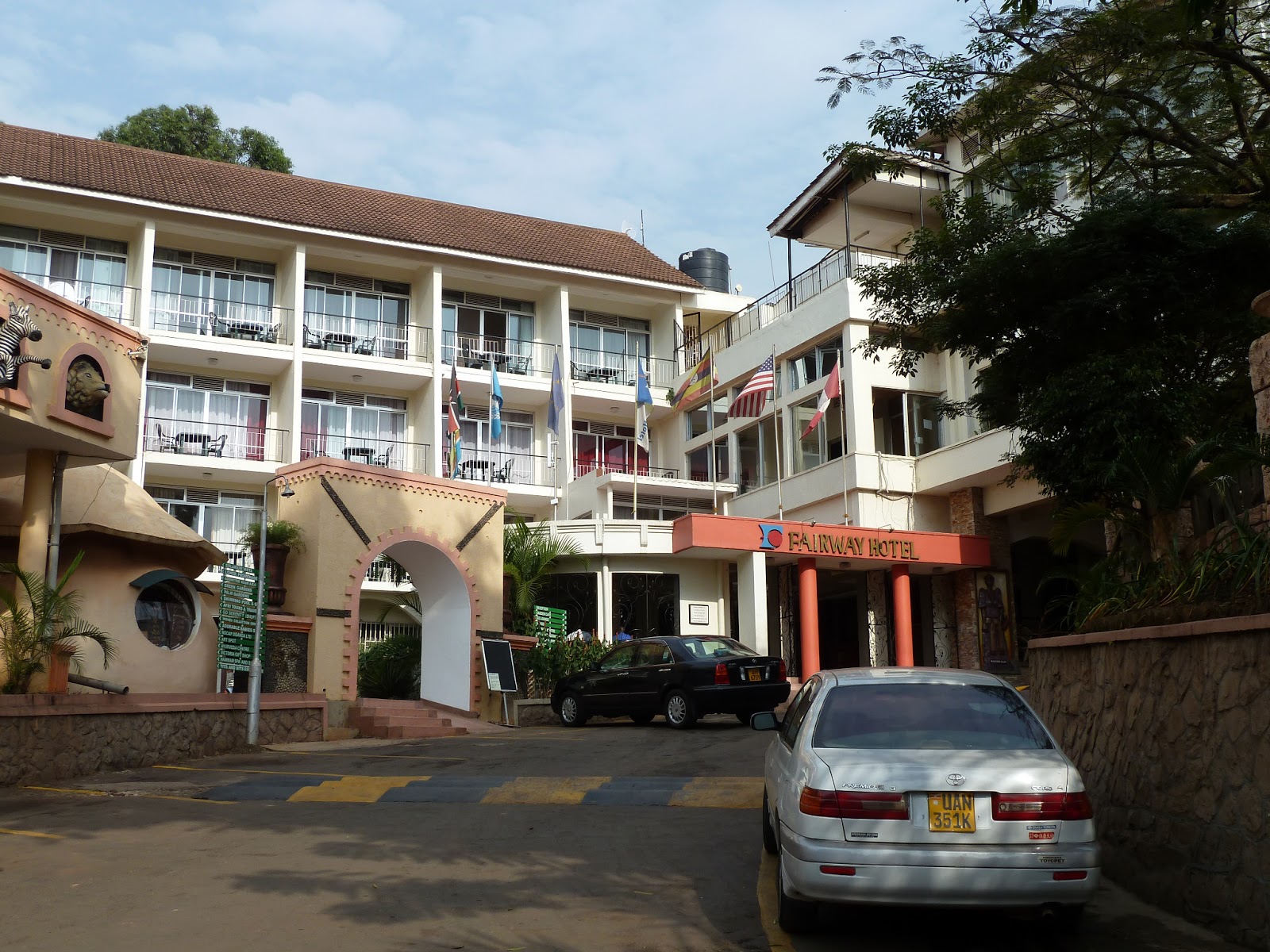
We are leaving Kampala today for the field station. We had a good stay and enjoyed our time here at the Fairway Hotel.


Saturday night, Michael and I ate dinner at nice restaurant called Piato that is next door to the French Embassy. We sat on a cool and refreshing outdoor patio and I had some wonderful butter chicken and black forest cake. I would highly recommend Piato to anyone that finds themselves in Kampala.

We spent the day relaxing yesterday. We walked down to the Oasis shopping mall and then sat in a coffee shop reading and drinking very good espresso. Afterwards, we strolled around the mall where I was struck by the juxtaposition of Ugandan and western cultures. Last night we had a nice meal at one of the hotel restaurants that serves a combination of Indian and Chinese food. The hotel restaurants were very convenient and as a bonus the food was good really very good. KNowing it was my last for a couple months, I took a nice long and hot shower this morning, trying to savor it.  

Friday, June 14, 2013

Back in Uganda!

I am very happy to be back in Uganda! This trip I brought an undergrad, Michael, from the University of New Hampshire with me to help with field work and to work on a project of his own. We just arrived last night and are in Kampala now for just a few days. It's a noisy and dirty city, so I'm really looking forward to getting back to the foothills of the Rwenzori mountains and the field station at Kibale National Park.

This afternoon, I had a really nice meeting with a collaborator at the Makerere University Farm in Gayaza. They have a really nice field station there and the students majoring in agriculture at the university have to spend a year living and studying there. Tomorrow we are going shopping and Sunday we will do some touristy things, like visiting the Uganda National Museum and the Kasubi tombs. Pictures to follow soon.

Friday, February 1, 2013

Final week in Uganda (for now)

My last couple days at the field station were filled by watching the red colobus and black and white colobus monkeys that filled the tress around my bungalow as I worked to get everything packed up and put away in storage. It took some serious puzzle solving skills to get everything I wanted to leave packed into the one storage box I had, but I did it. I am fortunate that Colin Chapman of McGill University was willing to let me use some of his lab/storage space to keep my things. When I arrived I had three pieces of checked baggage and a full-sized carry-on. If I hadn't filled one large bag mostly with souvenirs, I could have made it home with one checked bag and a small carry-on. When I come back here in June it will be much easier to pack and prepare now that I know what to expect and I already have supplies over here.


My time here in Kampala has not been spent in meetings as I expected. My collaborator at Makerere Univerisity, who I was counting on to set up meetings, introduce me to other faculty members and show me around had her baby on Tuesday. I spent some time trying to get my soils ready for shipping. They are all ready to go but are waiting on some paper work for the permits and so they won't be shipped to me until the first week in March, Fortunately, I have a colleague who will be returning to Kampala for other business at that time and has agreed to finalize the soil shipment.

My bungalow mate Amy told me that I hadn't truly experienced Africa until I had a mango (or tumbu) fly. Well, I guess I have now truly experienced Africa, today I discovered I had acquired my first mango fly larvae. (Squeamish readers should not read the rest of this paragraph) I first noticed it as I experienced a bit of pain and an itch that came and went as, I suspect, the larvea moved around under my skin. When I went to look at it I realized right away what the problem was so I went to a store and bought some nail polish, then painted over the area and waited for the larvae to suffocate. Then I was able to peel back the nail polish and pop it out. Kind of gross, but not really that bad. I thought I was going to escape Africa without picking up one of these things, but hopefully it was just the one.

Tomorrow, I will spend my final day here at the Botanical Gardens next to Lake Victoria in Entebbe, close to the airport. My flight doesn't leave until 11:59pm so I will have quite a bit of time to kill, and I don't want to spend any more time than necessary in the airport. This will be the last entry in this blog until June, when I will return for nine more weeks of research and adventure in Uganda.


Sunday, January 27, 2013

Forest Soils and Queen Elizabeth National Park

Last week was a busy one! I finished the soil sampling by finding sites within Kibale National Park that were adjacent to the villages and farms I first took samples from. This was not quite as easy at it sounds. I found out that most of the forest that is directly adjacent to the farms I sampled soils from, is actually regenerating forest. These lands were once cultivated, then in 1993 when the official park boundaries were surveyed and established, farmers were moved off this land (sometimes by force) and the forest allowed to regrow. In future studies I will be very interested to see how the soils are responding to forest re-growth after cultivation, but this time I wanted virgin forest soils. That is where things got complicated. Access to virgin forest across from the villages I've been working in was extremely difficult to find. Especially when the Park does not have any good, recent forest maps that indicate trails and roads. Site selection was thus by trial and error, and involved a lot of driving around and frustration.


The end of the week was really much more fun. On Thursday morning I travelled south to Queen Elizabeth National Park. On the journey we crossed the equator and I was in the southern hemisphere for the first time. On Thursday afternoon I took a boat ride on the Kazinga Channel that runs between Lake George and Lake Edward. I saw an amazing number of hippos! I also saw elephants, Nile crocodiles, water buffalo, Uganda kob, a Nile monitor lizard and birds of just about every shape and size.


I spent the night at the Bush Lodge that is right on the Kazinga Channel. It was composed of permanent tents on stilts and was a nice place stay, although I didn't get much sleep, all the hippos and wart hogs surrounding the area were just too loud!

On Friday we left before sunrise and made our way to the Kasenyi Plains to drive the wildlife trails. We had a very fruitful morning spotting, kob, elephants, water buffalo, water bucks, a spotted hyena and a lion laying on top of a termite mound! We were very lucky to see a lion at all. My driver had spoken to many other guides that were frustrated they couldn't find any for their customers. 


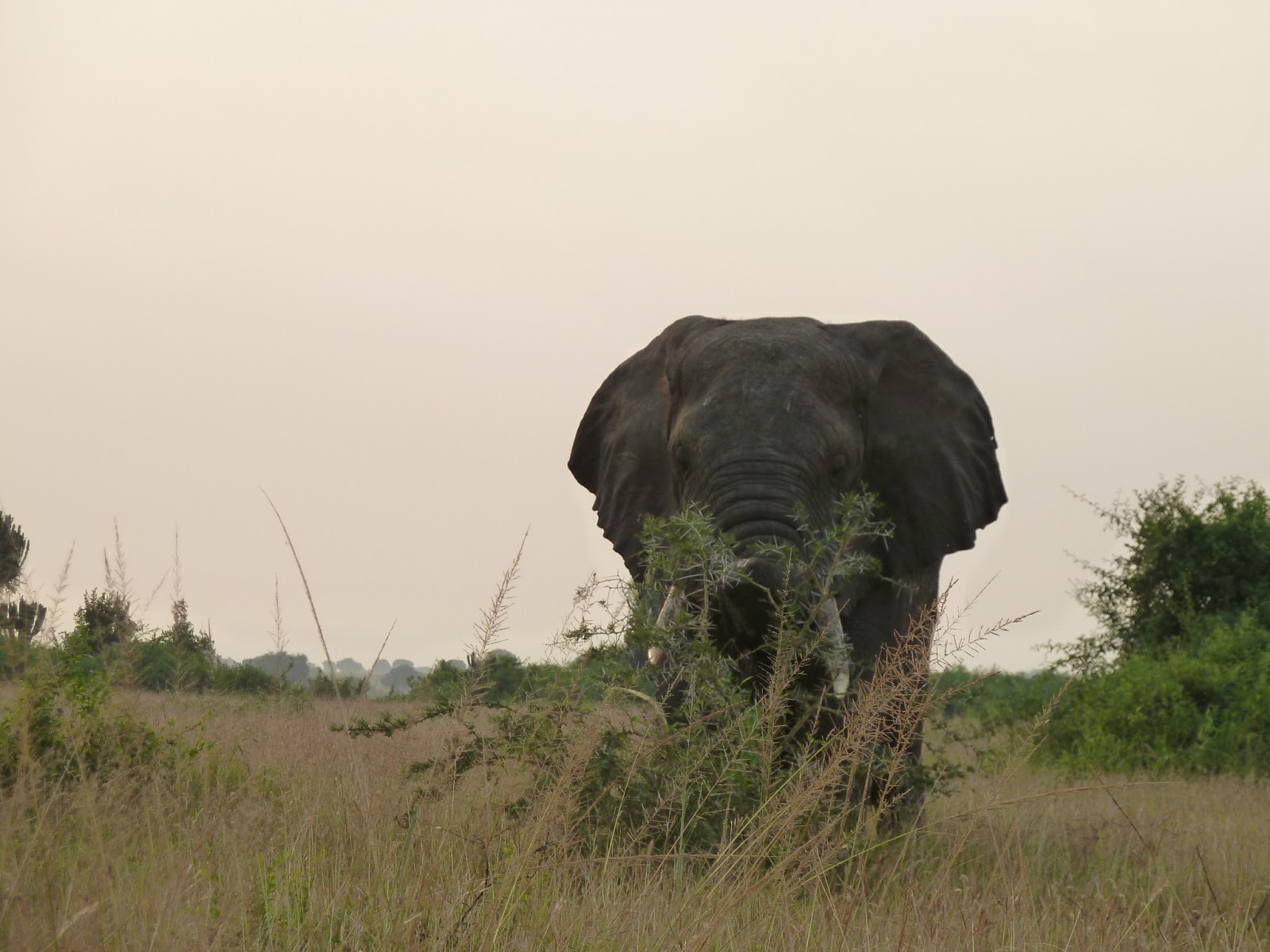
In the afternoon we drove down to Ishasha where there are rare tree-climbing lions. The road down is only 70 km but it took us over three hours because the condition of the road was so bad. During the trip we came upon an elephant at the side of the road. We stopped, turned the car off and waited quite a while for it to cross, but it wouldn't move. Finally, my driver asked if I thought we could drive by, and I said yes, as along as we go slow. I now know better. As soon as we were about opposite the elephant on the road, it got scared and started to charge at us. Fortunately my driver had the presence of mind to floor it and we escaped unscathed.  

When we arrived at Ishasha, we found this savannah system on fire and were forced to turn back because the smoke was too thick to drive through. These savannah are burned regularly to prevent the trees and brush from taking over.

  
I stayed the night at the Savannah Resort Hotel, which was extremely nice, but not too expensive. The next morning, we left again before sunrise and returned to Ishasha with hope that the fires had burned out. This was the case and we were able to see a completely changed landscape as well as another spotted hyena, herds of kob, water buffalo, and topi and numerous birds. 


We drove around the roads and around known lion trees for 3 hours, but saw no lions and decided to head back north. On the way back up the terrible 70 km road, we finally found the tree climbing lions we had been looking for in Ishasha. The picture is not great because of the distance, but trust me, there are three lions in this tree. I had a much better view through my binoculars.

 
We finished the trip with a visit to some of the explosion craters along Crater Drive back in the north end of the park. It was a spectacular trip and I wish I could have spent more time exploring.   

I'm off to Kampala on Tuesday and I can't believe how quickly time has passed. I am looking forward to the indoor plumbing at home, but will miss the people here when I leave.